Achillea millefolium (Common Yarrow) An all-star plant. Wildlife love the blooms, but Common Yarrow can also be used for a lawn.
View on Calscape (opens in a new tab)
Size: 2′ W × 2′ H
Flowering Season: spring, summer
Grows Well in Containers Supports the Most Life as a Keystone Species Native to Santa Ana Meets Parkway Requirements A Suitable Low Water Lawn Replacement Aesculus californica (California Buckeye) Typically grown as a multi-trunk tree, the buckeye produces flushes of large candle-like clusters of white flowers during the spring and summer. The flowers are a favorite for our native bees, but are toxic to the european honey bee. Drops its leaves in summer but can hold on to them slightly longer with supplemental water.
View on Calscape (opens in a new tab)
Size: 40′ W × 13–40′ H
Flowering Season: spring, summer
Attracts Native Bees Takes Pruning Well as a Hedge Supports the Most Life as a Keystone Species Native to Santa Ana Suitable as a Street Tree Agrostis pallens (Thingrass) A true turf replacement. Unfortunately, the turf rebate program considers this too similar to turf to count for the rebate.
View on Calscape (opens in a new tab)
Size: 1′ W × 2′ H
Flowering Season: spring
Birds Love Them Grows Well in Containers Native to Santa Ana Meets Parkway Requirements A Suitable Low Water Lawn Replacement Arctostaphylos (Manzanita) — Ground cover Recommendations:
A. 'John Dourley' A. 'Pacific Mist' Manzanita are known for their dark red bark and slow growth. They need little maintenance and generally pruning should be avoided. Manzanita berries are edible and can be processed into a cider-like drink.
View on Calscape (opens in a new tab)
Size: 6–8′ W × 2′ H
Flowering Season: spring, winter
Attracts Native Bees Birds Love Them Supports the Most Life as a Keystone Species Native to Santa Ana Meets Parkway Requirements Arctostaphylos (Manzanita) — Mid-sized Shrub Recommendations:
A. glauca (Bigberry Manzanita) Manzanita are known for their dark red bark and slow growth. They need little maintenance and generally pruning should be avoided. Manzanita berries are edible and can be processed into a cider-like drink.
View on Calscape (opens in a new tab)
Size: 12′ W × 15′ H
Flowering Season: spring, winter
Attracts Native Bees Birds Love Them Supports the Most Life as a Keystone Species Native to Santa Ana Suitable as a Street Tree Arctostaphylos (Manzanita) — Small shrub Recommendations:
A. glandulosa ssp. glandulosa (Eastwood Manzanita) A, 'Howard McMinn' Manzanita are known for their dark red bark and slow growth. They need little maintenance and generally pruning should be avoided. Manzanita berries are edible and can be processed into a cider-like drink.
View on Calscape (opens in a new tab)
Size: 8′ W × 3–12′ H
Flowering Season: spring, winter
Attracts Native Bees Birds Love Them Supports the Most Life as a Keystone Species Native to Santa Ana Artemisia californica (California Sagebrush) Recommendations:
A. californica 'Canyon Gray' Aromatic silvery-green foliage. The 'Canyon Gray' cultivar is lower growing and more tolerant of clay soil.
View on Calscape (opens in a new tab)
Size: 4–8′ W × 2–4′ H
Flowering Season: fall, summer
Supports the Most Life as a Keystone Species Native to Santa Ana Meets Parkway Requirements Asclepias fascicularis (Narrow Leaf Milkweed) A wonderful habitat plant and critical for our monarch population. However, not the most attractive. Recommended to tuck one into a sunny border where it can blend in with other greenery. And always plant our native milkweed because others are reported to promote the spread of disease among monarchs.
View on Calscape (opens in a new tab)
Size: 2′ W × 3′ H
Flowering Season: fall, summer
Attracts Native Bees Grows Well in Containers Native to Santa Ana Meets Parkway Requirements Baccharis pilularis ssp. consanguinea (Coyote Brush) Recommendations:
B. pilularis 'Pozo Surf' B. pilularis 'Pigeon-Point' B. pilularis 'Twin Peaks No. 2' An adaptable low growing shrub with a lovely bright green hue. Coyote Brush is an important habitat plant and its evergreen leaves provides a nice foundation in a garden.
View on Calscape (opens in a new tab)
Size: 7–8′ W × 2–6′ H
Flowering Season: fall, summer, winter
Attracts Native Bees Takes Pruning Well as a Hedge Supports the Most Life as a Keystone Species Native to Santa Ana Carex praegracilis (Field Sedge) A true turf replacement. Can be mowed but looks wonderful long in a field. Prefers seasonally wet locations and does well around swales.
View on Calscape (opens in a new tab)
Size: 3′ W × 1.5′ H
Light: full sun part sun part shade Flowering Season: summer
Native to Santa Ana Meets Parkway Requirements A Suitable Low Water Lawn Replacement Ceanothus (California Lilac) — Ground cover Recommendations:
C. 'Valley Violet' C. 'Centennial' A wonderful fast growing shrub. Flowers can be white or blue depending on selection.
View on Calscape (opens in a new tab)
Size: 4′ W × 2′ H
Flowering Season: spring
Attracts Native Bees Supports the Most Life as a Keystone Species Meets Parkway Requirements Ceanothus (California Lilac) — Mid-sized Shrub Recommendations:
C. arboreus (Island Ceanothus) C. 'Ray Hartman' C. megacarpus (Big Pod Ceanothus) C. oliganthus var. oliganthus (Hairy Ceanothus) Ceanothus is a diverse group of evergreen shrubs. The mid-sized species can be pruned as a small tree.
View on Calscape (opens in a new tab)
Size: 10–30′ W × 10–30′ H
Flowering Season: spring, winter
Attracts Native Bees Takes Pruning Well as a Hedge Supports the Most Life as a Keystone Species Native to Santa Ana Suitable as a Street Tree Cercocarpus betuloides (Mountain Mahogany) A very distinct and attractive shrub with unique feather like seeds. Takes pruning well and has a habit to grow tall and upright, which makes it great for hedges or narrow spaces.
View on Calscape (opens in a new tab)
Size: 10–12′ W × 8–20′ H
Flowering Season: spring, winter
Takes Pruning Well as a Hedge Supports the Most Life as a Keystone Species Native to Santa Ana Suitable as a Street Tree Chilopsis linearis (Desert Willow) A small tree with fragrant trumpet-shaped blooms that are a favorite nectar source for bees, hummingbirds, and butterfly. The 'Bubba' cultivar produces more blooms and is an absolute show stopper. This is a wonderful tree for small gardens.
View on Calscape (opens in a new tab)
Size: 20′ W × 20′ H
Flowering Season: fall, spring, summer
Attracts Native Bees Birds Love Them Suitable as a Street Tree Claytonia perfoliata (Rooreh) An attractive annual herb that can be used as a salad green. Can be grown into early summer, when lettuce would normally bolt. Seeds are available from Theodore Payne nursery.
View on Calscape (opens in a new tab)
Size: 1′ W × 1′ H
Flowering Season: spring, winter
Grows Well in Containers Native to Santa Ana Meets Parkway Requirements Clinopodium douglasii (Yerba Buena) Wonderful aromatic ground cover, makes a great tea. Delicate white flowers. Perfect for a shady border or in a hanging basket. Stems will root in the ground as it grows.
View on Calscape (opens in a new tab)
Size: 5′ W × 1′ H
Flowering Season: spring, summer
Attracts Native Bees Grows Well in Containers Meets Parkway Requirements A Suitable Low Water Lawn Replacement Eriogonum (Buckwheat) Recommendations:
E. fasciculatum (California Buckwheat) E. fasciculatum var. fasciculatum (California Buckwheat var. fasciculatum) E. parvifolium (Sea Cliff Buckwheat) E. arborescens (Santa Cruz Island Buckwheat) E. crocatum (Conejo Buckwheat) One of the most important and diverse plants groups to California. Buckwheats are abundant nectar sources, the seeds feed birds or can be processed into flour, and the leaves support numerous caterpillar. Flowers can range from white, pink, red, or yellow. E. crocatum is particularly striking with woolly silvery leaves and bright sulfur yellow flowers.
View on Calscape (opens in a new tab)
Size: 3–6′ W × 3–5′ H
Flowering Season: fall, spring, summer
Attracts Native Bees Birds Love Them Supports the Most Life as a Keystone Species Native to Santa Ana Meets Parkway Requirements Eschscholzia californica (California Poppy) A favorite among gardeners near and far. The poppy is a short lived perennial that grows and spreads without any extra care. Beautiful cup shaped flowers during the spring.
View on Calscape (opens in a new tab)
Size: 2′ W × 2′ H
Flowering Season: fall, spring, summer
Attracts Native Bees Grows Well in Containers Native to Santa Ana Meets Parkway Requirements Frangula californica (California coffeeberry) Recommendations:
F. californica 'Eve Case' F. californica 'Leatherleaf' F. californica 'Mound San Bruno' Makes berries that change from green to dark red from late summer through fall. The common cultivars offered are smaller than the species.
View on Calscape (opens in a new tab)
Size: 6–15′ W × 6–15′ H
Flowering Season: summer
Birds Love Them Takes Pruning Well as a Hedge Supports the Most Life as a Keystone Species Native to Santa Ana Suitable as a Street Tree Heteromeles (Toyon) Recommendations:
H. arbutifolia (Toyon) H. arbutifolia 'Davis Gold' Can be pruned to almost any shape and size. Makes red berries in winter that birds love. The 'Davis Gold' cultivar has yellow berries instead.
View on Calscape (opens in a new tab)
Size: 15′ W × 20′ H
Flowering Season: summer
Birds Love Them Takes Pruning Well as a Hedge Supports the Most Life as a Keystone Species Native to Santa Ana Suitable as a Street Tree Isocoma menziesii (Menzies' Goldenbush) Semi-summer deciduous with small bright yellow blooms. Provides an important nectar source during summer. Numerous small native bees are attracted to it.
View on Calscape (opens in a new tab)
Size: 4′ W × 4–5′ H
Flowering Season: fall, spring, summer
Attracts Native Bees Native to Santa Ana Meets Parkway Requirements Juglans californica (Southern California Black Walnut) A beautiful tree for large spaces. The walnuts are edible but difficult to process. Drops its leaves in winter
View on Calscape (opens in a new tab)
Size: 50–75′ W × 50–75′ H
Flowering Season: spring
Supports the Most Life as a Keystone Species Native to Santa Ana Suitable as a Street Tree Lepechinia fragrans (Fragrant Pitcher Sage) An amazing smelling low shrub with pale fuzzy leaves and small but attractive blooms.
View on Calscape (opens in a new tab)
Size: 5′ W × -2′ H
Flowering Season: fall, spring, summer
Takes Pruning Well as a Hedge Meets Parkway Requirements Lyonothamnus floribundus (Catalina Ironwood/Island Ironwood) Large flower clusters, attractive bark and fern-like foliage makes this an especially attractive tree in the landscape. Prefers good drainage but can tolerate heavy soil. Beautiful in groves.
View on Calscape (opens in a new tab)
Size: 20′ W × 40′ H
Flowering Season: spring, summer
Suitable as a Street Tree Malva assurgentiflora (Malva Rosa) A great native alternative to hibiscus, and very attractive to butterflies.
View on Calscape (opens in a new tab)
Size: 8′ W × 8′ H
Flowering Season: spring, summer, winter
Takes Pruning Well as a Hedge Native to Santa Ana Mirabilis laevis (Desert Wishbone-bush) An excellent ground cover with bright pink blooms in spring. Prefers drainage, but tolerates clay—especially when planted on a small mound. Goes dormant in summer but still looks nice in dormancy.
View on Calscape (opens in a new tab)
Size: 8′ W × 1′ H
Flowering Season: spring, winter
Native to Santa Ana Meets Parkway Requirements Monardella villosa (Coyote Mint) Grows near Santa Barbara and north further north. But the leaves have a lovely scent and butterflies, bees, and hummingbirds enjoy it as a nectar source.
View on Calscape (opens in a new tab)
Size: 3′ W × 2′ H
Flowering Season: summer
Attracts Native Bees Grows Well in Containers Meets Parkway Requirements Muhlenbergia rigens (Deergrass) A large mounding grass that provides wonderful structure to the garden year around.
View on Calscape (opens in a new tab)
Size: 4′ W × 4–5′ H
Flowering Season: spring
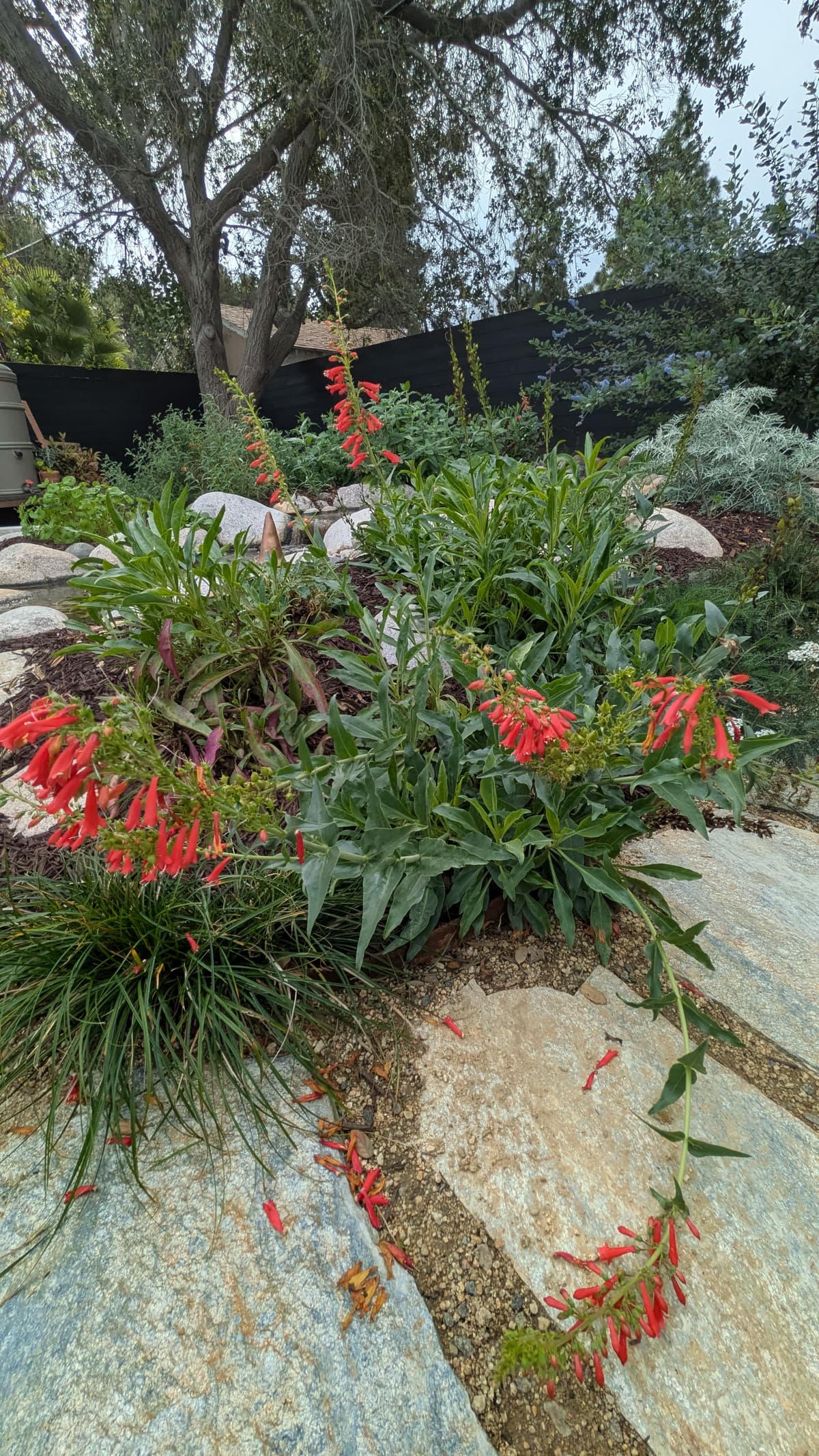
Birds Love Them Grows Well in Containers Native to Santa Ana Meets Parkway Requirements Penstemon — Perennial Recommendations:
P. centranthifolius (Scarlet Bugler) P. heterophyllus (Foothill Penstemon) P. spectabilis (Showy Penstemon) P. heterophyllus 'Margarita BOP' Showy perennials that hummingbirds and bees adore. Flowers bloom along a long stem and can range from white, blue, or red depending on species.
View on Calscape (opens in a new tab)
Size: 2–8′ W × 3–6′ H
Flowering Season: spring, summer, winter
Attracts Native Bees Birds Love Them Grows Well in Containers Native to Santa Ana Meets Parkway Requirements Platanus racemosa (California Sycamore) A fast growing plant that likes a regular water. Sycamore are one of Santa Ana's approved street trees. 'Roberts' is a disease resistant cultivar.
View on Calscape (opens in a new tab)
Size: 40′ W × 50′ H
Flowering Season: spring, winter
Birds Love Them Supports the Most Life as a Keystone Species Native to Santa Ana Suitable as a Street Tree Prunus (Cherry) Recommendations:
P. ilicifolia ssp. lyonii (Catalina Cherry) P. ilicifolia ssp. ilicifolia (Hollyleaf Cherry) A hardy evergreen that forms edible fruits in summer. A favorite for birds. Can handle dry, rocky slopes but tend to grow larger where there is more moisture.
View on Calscape (opens in a new tab)
Size: 5–20′ W × 5–40′ H
Flowering Season: spring, winter
Attracts Native Bees Birds Love Them Takes Pruning Well as a Hedge Supports the Most Life as a Keystone Species Suitable as a Street Tree Quercus (Oaks) Recommendations:
Q. agrifolia (Coast Live Oak) Q. engelmannii (Engelmann Oak) Large graceful trees that are known around the world for how much life they support. Native oaks require full sun and dry summers.
View on Calscape (opens in a new tab)
Size: 30–90′ W × 30–80′ H
Flowering Season: spring, winter
Attracts Native Bees Birds Love Them Supports the Most Life as a Keystone Species Native to Santa Ana Suitable as a Street Tree Quercus berberidifolia (Scrub Oak) Scrub Oaks are tough, compact shrubs with rigid, somewhat prickly leaves. Known around the world for how much life they support. Native oaks require full sun and dry summers.
View on Calscape (opens in a new tab)
Size: 15′ W × 15–20′ H
Flowering Season: spring, winter
Attracts Native Bees Birds Love Them Supports the Most Life as a Keystone Species Native to Santa Ana Suitable as a Street Tree Rhus (Sumac) Recommendations:
R. integrifolia (Lemonade Berry) R. ovata (Sugar Bush) R. aromatica (Fragrant Sumac) Sumacs are tough, drought-tolerant, and provide food and shelter for wildlife. They handle pruning very well and can even be cut all the way to the ground periodically to encourage new shoots. Recommended varieties have edible red berries.
View on Calscape (opens in a new tab)
Size: 8–30′ W × 8–30′ H
Flowering Season: spring, winter
Attracts Native Bees Birds Love Them Takes Pruning Well as a Hedge Supports the Most Life as a Keystone Species Native to Santa Ana Suitable as a Street Tree Ribes (Currant) Recommendations:
R. indecorum (White Flowering Currant) R. speciosum (Fuchsiaflower Gooseberry) R. viburnifolium (Catalina Currant) R. aureum (Golden Currant) Forms edible fruit which is an important food source for many bird species. Beautiful when in bloom, but winter deciduous.
View on Calscape (opens in a new tab)
Size: 3–8′ W × 3–8′ H
Light: full sun part sun shade Flowering Season: spring
Attracts Native Bees Birds Love Them Supports the Most Life as a Keystone Species Native to Santa Ana Rosa californica (California Wildrose) Less showy than traditional roses, but the flowers are attractive and the rose hips are a beautiful deep red.
View on Calscape (opens in a new tab)
Size: 10′ W × 10′ H
Light: full sun part sun part shade Flowering Season: spring, summer
Salvia (Sage) Recommendations:
S. apiana (White Sage) S. mellifera (Black Sage) S. clevelandii (Cleveland Sage) S. spathacea (Hummingbird Sage) An adaptable genus that hummingbirds love. White Sage and Hummingbird Sage are especially nice fragrances but there's all kinds.
View on Calscape (opens in a new tab)
Size: 3–10′ W × 3–6′ H
Flowering Season: spring, summer, winter
Attracts Native Bees Birds Love Them Native to Santa Ana Meets Parkway Requirements Scrophularia californica (Bee Plant) A wonderful plant for wildlife and for back of perennial borders.
View on Calscape (opens in a new tab)
Size: 3′ W × 4′ H
Flowering Season: spring, winter
Attracts Native Bees Grows Well in Containers Native to Santa Ana Sisyrinchium bellum (Blue-eyed Grass) A tough perennial that does great in our clay soil once established. Dies back after flowering in summer.
View on Calscape (opens in a new tab)
Size: 2′ W × 1′ H
Flowering Season: spring, winter
Grows Well in Containers Native to Santa Ana Meets Parkway Requirements Solidago californica (California Goldenrod) Can be an aggressive spreader but birds and pollinating insects love this plant. A wonderful addition to a habitat garden.
View on Calscape (opens in a new tab)
Size: 3′ W × 2–5′ H
Flowering Season: fall, summer
Attracts Native Bees Supports the Most Life as a Keystone Species Native to Santa Ana Stipa pulchra (Purple Needle Grass) Our state grass. Produces a large amount of seeds, which attract birds and other wildlife. But avoid planting where pets will go—the needles on seeds can get stuck in fur.
View on Calscape (opens in a new tab)
Size: 2′ W × 3′ H
Flowering Season: spring
Attracts Native Bees Native to Santa Ana Meets Parkway Requirements .jpg&w=1200&q=75)
.jpg&w=1200&q=75)
.jpg&w=1200&q=75)
%2520%25E2%2580%2594%2520Ground%2520cover.jpg&w=1200&q=75)
%2520%25E2%2580%2594%2520Mid-sized%2520Shrub.jpg&w=1200&q=75)
%2520%25E2%2580%2594%2520Small%2520shrub.jpg&w=1200&q=75)
.jpg&w=1200&q=75)
.jpg&w=1200&q=75)
.jpg&w=1200&q=75)
.jpg&w=1200&q=75)
%2520%2520%25E2%2580%2594%2520Ground%2520cover.jpg&w=1200&q=75)
%2520%25E2%2580%2594%2520Mid-sized%2520Shrub.jpg&w=1200&q=75)
.jpg&w=1200&q=75)
.jpg&w=1200&q=75)
.jpg&w=1200&q=75)
.jpg&w=1200&q=75)
.jpg&w=1200&q=75)
.jpg&w=1200&q=75)
.jpg&w=1200&q=75)
.jpg&w=1200&q=75)
.jpg&w=1200&q=75)
.jpg&w=1200&q=75)
.jpg&w=1200&q=75)
.jpg&w=1200&q=75)
.jpg&w=1200&q=75)
.jpg&w=1200&q=75)
.jpg&w=1200&q=75)
.jpg&w=1200&q=75)
.jpg&w=1200&q=75)
.jpg&w=1200&q=75)
.jpg&w=1200&q=75)
.jpg&w=1200&q=75)
.jpg&w=1200&q=75)
.jpg&w=1200&q=75)
.jpg&w=1200&q=75)
.jpg&w=1200&q=75)
.jpg&w=1200&q=75)
.jpg&w=1200&q=75)
.jpg&w=1200&q=75)
.jpg&w=1200&q=75)